
A Look at Big Walk: How the Co-op Hiking Game Measures Up
Big Walk, from Untitled Goose Game developer House House, is a co-op hiking and puzzle game built around proximity chat and player communication. Set on a sprawling island wilderness, it supports up to a dozen players, b…
"Chris, I think you're muted. Your nose has gone small."
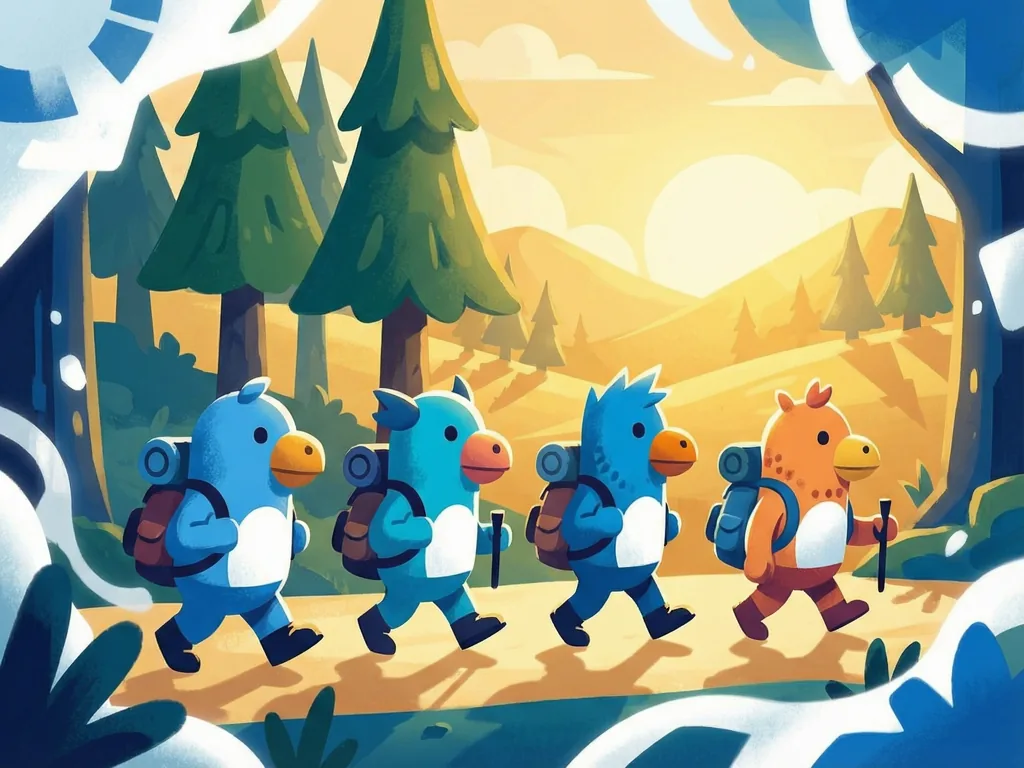
Big Walk, the new game from Melbourne studio House House, is hard to pin down at first. If you're wondering whether it resembles the developer's breakout hit, the answer is: sort of. There are no geese this time, though the colourful avatars have a faintly birdlike quality — big or small, that nose is slightly beakish. It shares the same gleeful mischief, the same playful exuberance, and it's stuffed with countless delightful little touches. Otherwise, it's not much like Untitled Goose Game at all.
What it is, is a hangout game of the highest order — a superior class of what we apparently must now call "friendslop." It's also a co-operative puzzle game of sorts, built for small groups; certain elements are retuned for two, three or four players, but up to a dozen people can join if you have the numbers. Beneath all that, though, it's really about the frequent joys and occasional frustrations of human communication.
Half Heard, Half Lost
Big Walk feels like going on an adventure with friends while being slightly hard of hearing. Its proximity chat — crucial to nearly everything great about the game — is tuned aggressively: you don't need to stray far from your mates to slip out of earshot. And that's exactly the point. You get the pleasure of larking about together in the wild, juxtaposed with the feeling of being alone, whether you wander off on purpose or simply lose sight of the group.
That contrast defines the whole experience. The setting is a sprawling island wilderness dotted with colourful man-made objects and landmarks — purposeful artifice meets untamed nature, a tension that lends the place a thrilling liminality. Much of the map is loose and relaxed, with room to explore, chat, and take in the views. Then there are pockets of focused space where you must work as a team to complete challenges.
The curved, red rewards for solving these collaborative puzzles — vaguely resembling a bottle-gourd — are your main form of progression, unlocking genuinely transformative features. They have no official name, but our group quickly adopts one after our host decides they look like a certain canine chew toy. The name sticks, and soon it's part of our shared language: "I dropped the kong off the cliff."
Here's the thing: someone will drop the kong off the cliff. It's perfectly round, smooth, and heavier at the bottom — meaning it rolls the moment you set it down. That's Big Walk in a nutshell: if there's an opportunity for chaos, its makers grasp it with both hands.
A Wilderness That Rewards Wandering
The island itself is largely player-ambivalent — never hostile, even if night makes you instinctively wonder what's out there. (The island is clearly modelled on Australia, but arachnophobes can relax: the only eight-legged creature you'll see is a tower of four players.) The designer's hand is everywhere, in the best way. You never need a detective mode or an environment ping because something big and bright always draws the eye.
That comfort lets the world feel more authentic: dense foliage, properly rocky rocks, high peaks, deep valleys, sheer cliffs. You don't glide effortlessly over this terrain. Exploration can occasionally feel awkward — more than once a group member got gently stuck between two rocks — though I've yet to see anyone truly trapped. And when you discover you can sprint, click the right stick, and hurtle downhill on your backside, pipe-cleaner legs flailing? Unfettered joy. Fifteen hours later, on my umpteenth slide, the pleasure hadn't dimmed.
When darkness falls — with alarming haste, and truly dark, Echoes of the Eye dark — you'll want a light. Torches exist, but so do bulbous little lamps, also prone to rolling if you give in to the temptation to dropkick them. Placed in the circular receptacles scattered across the map, they mark where you've been — or, if your group has split up, point the way to a reunion. The flare gun serves a similar purpose.
The Art of Getting Separated
Getting split up is commonplace in Big Walk's great outdoors. Exterior puzzles regularly force you apart — one player might launch a clockwork bomb while another races to retrieve it before it pops. This encourages you to think about staying in contact. Walkie-talkies help, but until you get a backpack — what a revelation that moment is — you can't carry a second object. No separator is more effective than human curiosity anyway: the friend who beelines for something on the horizon without checking you're following, or strolls casually off a sheer drop, their "aaaaaah!" echoing like a Looney Tunes pratfall.
Happily, you're never truly lost for long. Head to the tower on the nearest hill and launch a firework, or trek back to base and leave a message on the whiteboard. There's even a frisson to being alone — our group briefly plotted a four-player session where one member believes it's a three, the fourth playing a malevolent presence.
The sternest tests await indoors. Puzzles typically put you in separate rooms, each holding an incomplete picture, and your task is to make it whole — describing what you can see to someone who can't, or inventing a system of gestures when you can see each other but can't hear. It's a useful reminder that a different perspective can illuminate your own. House House even makes you wait a few exquisite, agonising seconds before confirming whether your solution is right. The anticipation!
Then: the release. A party blower, a shower of confetti, and a screw slowly unthreading from a vice to free your round, red prize — a low-key celebration that never stops feeling satisfying. The sound effect when you place your reward belongs among the all-time greats: a bassy, otherworldly reverberation that ripples across the entire island, telling stragglers where you are. I won't spoil the ceremony for filling every slot in a tower, but more games could stand to take notes.
Verdict
At times it feels like you could explore this place forever. Between Sam Gill and Luke Neher's excellent soundtrack (portable radios let you listen as you roam) and Em Halberstadt's award-worthy sound design, Big Walk is a game that wants you to put your phone down, get lost with your friends, and find your way back together. It's the rare co-op game where the communication itself is the puzzle — and the reward.
Source: Eurogamer
Comments (0)