Combat takes center stage in Onimusha: Way of the Sword
Capcom's Onimusha returns after 20 years with Way of the Sword, starring Miyamoto Musashi in a modernized action formula. Combat excels with parries, deflections, and Issen attacks, though the semi-open world of Eastern …
Source: GameSpot Reviews
Capcom's samurai series Onimusha has returned after a 20-year absence, and Way of the Sword justifies the wait by putting combat at the center of a modernized take on the formula. Gone are the fixed camera angles and pre-rendered backgrounds of the earlier games, replaced by layered melee encounters informed by two decades of action game design. The fifth mainline entry keeps the franchise's signature blend of Japanese history and mythology alongside Capcom's knack for creative creature design, though its shift to a semi-open-world structure proves to be the game's weakest element. Even so, the swordplay is strong enough to carry it.
The protagonist is Miyamoto Musashi, the legendary swordsman of Japanese history, portrayed here in his early 20s. His cockiness and swagger are immediately apparent, and the character is modeled after the late actor Toshiro Mifune, known for his work with Akira Kurosawa on films like Seven Samurai and Yojimbo, as well as for playing Musashi in Hiroshi Inagaki's Samurai trilogy. Capcom has a history of using real actors' likenesses in Onimusha, including Yusaku Matsuda and Jean Reno, but the leap in fidelity here is clear. Facial capture animation sells every eyebrow raise and smirk, giving Musashi personality even in silence.
At the story's outset, Musashi arrives in Edo-era Kyoto determined to prove himself. After defeating a clan leader in a duel, he is attacked by the demonic Genma and survives only by accepting an Oni gauntlet from a mysterious figure. Unlike past protagonists who wielded Oni powers to save the world, Musashi wants to be rid of the gauntlet, viewing it as a shortcut that undermines his own skill. Watching him wrestle with that conviction while allies depend on him to protect Kyoto gives the narrative some weight. The broader plot is straightforward, with cartoonishly evil villains providing momentum, and the opening hours suffer from frequent cutscene interruptions before settling into a better rhythm.
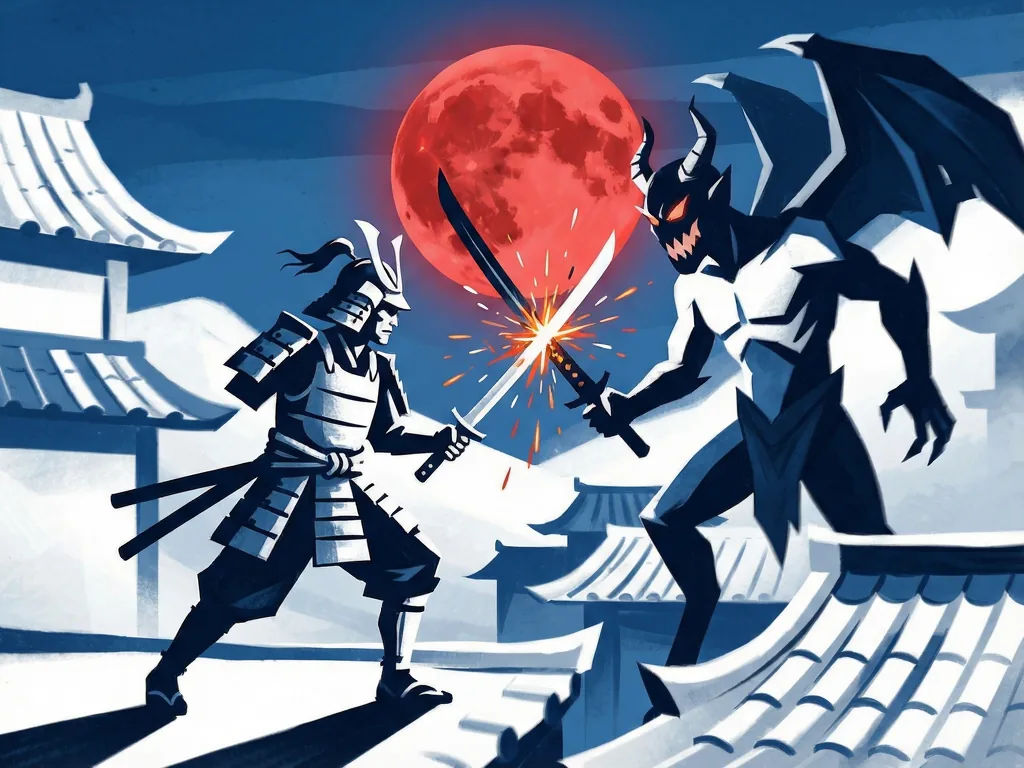
Combat is where the game excels. It sits between the combo-heavy style of Devil May Cry and Ninja Gaiden and the punishing methodical approach of souls-likes. Light and heavy attacks chain together with a satisfying heft, and Musashi swings his katana like a person who has to put muscle behind every strike. Blocking, parrying, and deflecting form the core of the system. Parries open enemies up for quick punishment, while deflecting chips away at their stamina until they become exhausted and vulnerable, letting you deal heavy damage or even slow time during boss fights to target specific body parts. A well-timed Reflex Dodge against unarmed strikes allows for stylish evasions and reversal of grab attacks.
The Issen attack, a series staple, returns for those willing to risk it. Striking just before an enemy's blow lands triggers an instant kill on most regular foes, and the timing is tighter than any other defensive option, though it can be chained for greater rewards. Parries and deflections build toward Blazing State, which coats Musashi's blade in blue flame, boosts attack power, and increases soul drops. Oni Armaments add further variety, from the dual Two Celestials blades to the naginata Wind-Whipper, the stamina-crushing Earth-Shaker hammers, and the Firebird Flute. Environmental options exist too, like flipping tables as shields or shoving enemies into standing torches.
The semi-open world of Eastern Kyoto is the game's major flaw. Side quests, including the "Mysteries of Kyoto" missions tied to author Murasaki Shikibu, are formulaic and almost always end in killing another Genma. Archery challenges force returns to earlier locations, and while the upgrade materials they award make skipping them costly, the content feels superfluous. The traditional levels fare far better, such as an underground lab where a twisted Genma fuses humans and animals into monstrosities, or the climb up Mount Oe at twilight toward a castle at the summit.
Despite the misstep of its open structure, Onimusha: Way of the Sword is a strong comeback, anchored by exceptional combat and some of the best boss fights in recent memory. The potential for something greater is always visible, but what's here still ranks among the upper tier of modern action games.
Source: GameSpot

Comments (0)